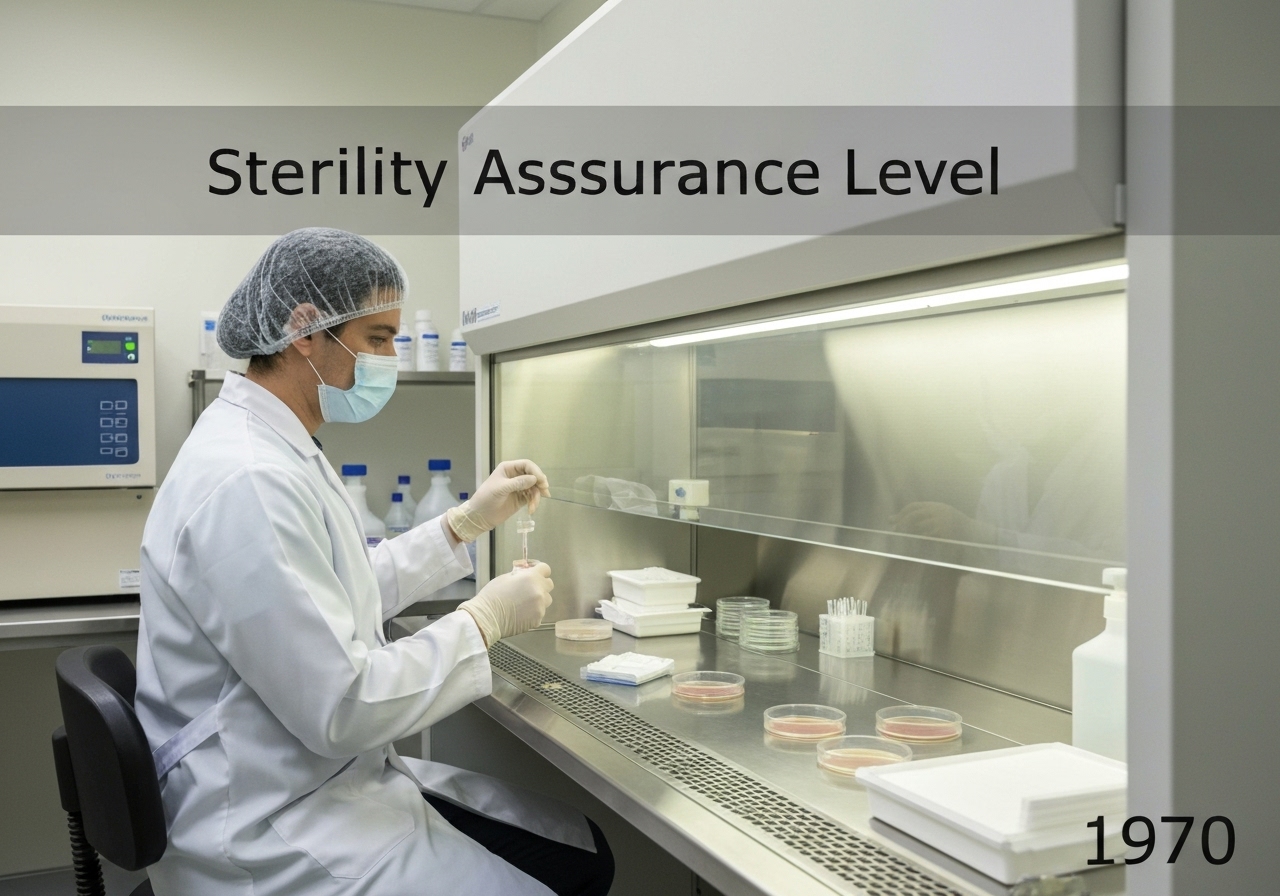
SAL(멸균 허용 수준)은 멸균 후 제품에 생존 가능한 미생물이 하나라도 남아 있을 확률을 나타내는 정량적 척도입니다. 의료기기에 일반적으로 요구되는 SAL은 10⁻⁶으로, 멸균되지 않은 제품이 존재할 확률이 백만분의 일이라는 의미입니다. 이러한 확률적 접근 방식은 절대적인 멸균 상태를 증명할 수 없고, 단지 공정으로부터 통계적으로 추론할 수 있다는 점을 인정하는 것입니다. 확인.

(설명을 위한 생성된 이미지입니다)
SAL(멸균 허용 수준)은 멸균 후 제품에 생존 가능한 미생물이 하나라도 남아 있을 확률을 나타내는 정량적 척도입니다. 의료기기에 일반적으로 요구되는 SAL은 10⁻⁶으로, 멸균되지 않은 제품이 존재할 확률이 백만분의 일이라는 의미입니다. 이러한 확률적 접근 방식은 절대적인 멸균 상태를 증명할 수 없고, 단지 공정으로부터 통계적으로 추론할 수 있다는 점을 인정하는 것입니다. 확인.

The concept of the Sterility Assurance Level (SAL) is rooted in the understanding that microbial death follows first-order kinetics, meaning it is a probabilistic event. It is impossible to prove that every single microorganism on an object has been killed; one can only calculate the probability of a microbe surviving the process. The SAL is this probability. For instance, an SAL of [latex]10^{-6}[/latex] does not mean one contaminated item exists for every million produced. Instead, it means there is a one-in-a-million chance for any given item to harbor a single viable microorganism after the sterilization process. This statistical approach is fundamental to the validation of sterilization cycles in regulated industries like pharmaceuticals and medical devices. To establish a cycle that achieves a desired SAL, manufacturers perform validation studies. This often involves placing biological indicators (BIs), which are standardized preparations of highly resistant bacterial spores (like Geobacillus stearothermophilus for steam or Bacillus atrophaeus for EtO), in the most challenging locations within a sterilization load. The process parameters (e.g., time, temperature, concentration) are then adjusted and tested until they consistently achieve a complete kill of the BIs. The cycle is then extended for a ‘half-cycle’ or more to provide a safety margin, ensuring the process can deliver the target SAL of [latex]10^{-6}[/latex] or better. The choice of SAL depends on the intended use of the product. Items that will come into contact with compromised tissue, such as surgical implants and injectable drugs, require the most stringent SAL of [latex]10^{-6}[/latex]. For items that contact intact skin, a lower SAL of [latex]10^{-3}[/latex] may be acceptable.
SAL(멸균기준)이 규제 표준으로 공식화된 것은 20세기 후반 미국 식품의약국(FDA)과 국제표준화기구(ISO) 등의 주도로 이루어졌습니다. 이전에는 멸균 상태를 절대적인 것으로 간주하여, 제품이 멸균되었거나 멸균되지 않았다고만 여겼습니다. 그러나 제조 규모가 확대되고 오염 위험에 대한 이해가 깊어짐에 따라, 보다 엄격하고 정량적인 기준이 필요하게 되었습니다. 멸균에 대한 정성적 정의에서 확률적 정의로의 전환은 중요한 진전이었습니다. 이는 공정 검증을 위한 과학적이고 타당한 근거를 제공하여 제조업체가 규제 기관에 멸균 방법의 효과성과 재현성을 입증하고 환자에게 일관된 수준의 안전을 보장할 수 있도록 했습니다.
현재 하루 4만 건이 넘는 봇 트래픽을 차단하기 위해 이 콘텐츠는 커뮤니티 회원만 이용할 수 있습니다.
> 로그인 < 또는 >등록 < 이 콘텐츠를 비롯한 모든 제한된 콘텐츠와 도구는 (100% 무료로) 이용할 수 있습니다.
무균 보증 수준(SAL)
(날짜를 알 수 없거나 관련이 없는 경우, 예를 들어 "유체역학"의 경우, 주목할 만한 등장 시기를 대략적으로 추정하여 제공합니다.)
고화질 이미지 및 다운로드는 등록된 회원에게만 100% 무료로 제공됩니다.
> 로그인 <