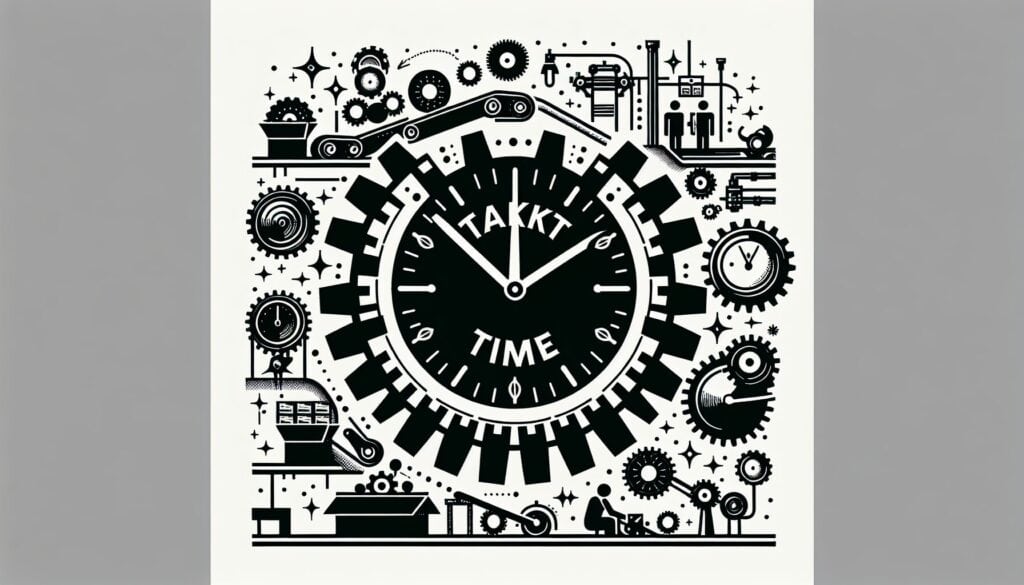
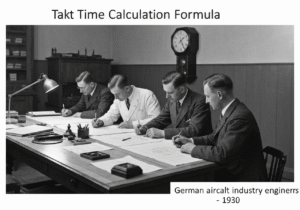
Calculated as available production time divided by customer demand over a specific period. It sets the "rhythm" or "beat" at which products need to be completed to meet customer requirements.
長所
Ensures production is aligned with customer demand, preventing overproduction or underproduction; Helps identify bottlenecks and areas where capacity doesn't match demand; Facilitates production smoothing (heijunka).
短所
Requires accurate demand forecasting and stable production times; Can be challenging to apply in high-variety, low-volume environments or where demand is highly erratic; External factors can easily disrupt a takt-based system.
カテゴリー:
リーンシックスシグマ, 製造業, プロジェクト管理
最適な用途:
Matching the rate of production directly to the rate of customer demand to ensure efficient flow and resource utilization.
Takt Time is particularly beneficial in industries such as automotive manufacturing, electronics assembly, and consumer goods production, where understanding and aligning production cycles with customer expectations is essential for operational success. This methodology is most effectively applied during the planning and execution phases of production projects, where cross-functional teams—including engineers, production managers, and supply chain specialists—can collaboratively analyze demand patterns and production capacities. For example, in automotive assembly lines, Takt Time calculations enable manufacturers to establish a rhythm that accommodates customer orders while minimizing idle time and resource waste. This process reveals capacity discrepancies, allowing teams to address bottlenecks quickly. In situations where demand fluctuates, Takt Time can facilitate production smoothing through heijunka, which balances workloads across various production stages, ensuring consistency and predictability in output. This approach not only enhances overall efficiency but also improves responsiveness to market demands, as manufacturers can adjust their operations based on real-time customer feedback. Furthermore, implementing Takt Time in conjunction with lean manufacturing principles can lead to continuous improvement initiatives, driving innovation in design and engineering processes, which are crucial for maintaining competitiveness in fast-paced markets.
この方法論の主なステップ
Calculate Takt Time by dividing available production time by customer demand over a specific period.
Determine the production rate needed per minute or hour based on the calculated Takt Time.
Align workstations and processes to ensure tasks are completed within Takt Time limits.
Monitor production in real-time to ensure adherence to Takt Time.
Identify and analyze bottlenecks that disrupt the flow of production relative to Takt Time.
Implement adjustments or improvements in processes to meet Takt Time consistently.
Review and recalibrate Takt Time as needed in response to changes in demand or production capacity.
プロのヒント
Regularly review Takt Time in response to fluctuations in customer demand to maintain production efficiency and responsiveness.
Utilize real-time data analytics for monitoring production rates and adjusting workflows dynamically according to Takt Time requirements.
Integrate cross-functional team workshops to identify potential improvements in processes that impact Takt Time and overall production flow.