p進数
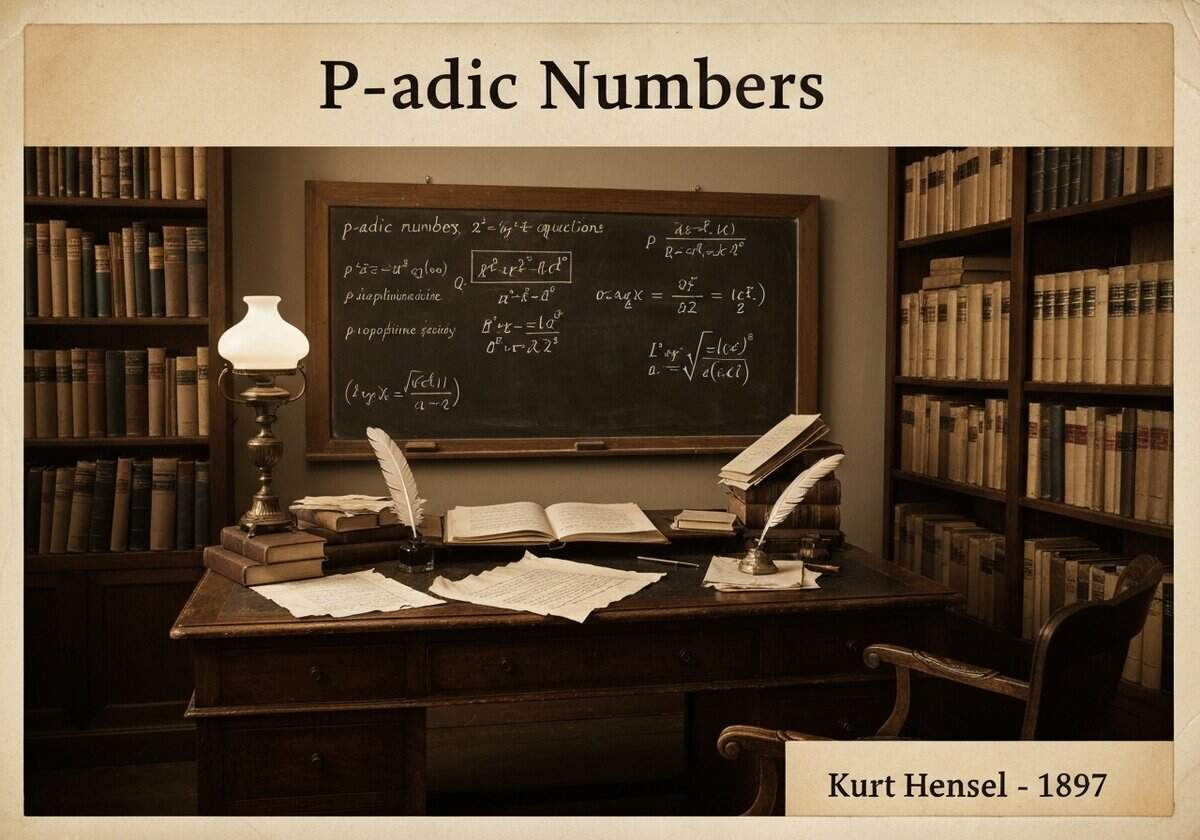
For a prime number [latex]p[/latex], the p-adic numbers form an extension of the rational numbers that is topologically different from the real numbers. While real numbers are a completion of [latex]mathbb{Q}[/latex] with respect to the usual absolute value metric, the p-adic numbers are the completion of [latex]mathbb{Q}[/latex] with respect to the p-adic metric, where numbers are “small” if they are divisible by a high power of [latex]p[/latex].
The concept of p-adic numbers, introduced by Kurt Hensel, provides a powerful and alternative way to extend the field of rational numbers. The construction is based on a different notion of distance, or absolute value. For a fixed prime [latex]p[/latex], the p-adic absolute value [latex]|x|_p[/latex] of a non-zero rational number [latex]x[/latex] is defined as follows: first, write [latex]x = p^n (a/b)[/latex] where [latex]a, b[/latex] are not divisible by [latex]p[/latex]. Then [latex]|x|_p = p^{-n}[/latex]. For example, for [latex]p=5[/latex], the number 75 is [latex]5^2 \cdot 3[/latex], so [latex]|75|_5 = 5^{-2} = 1/25[/latex]. A number is considered “small” in the p-adic sense if it is divisible by a high power of [latex]p[/latex].
This p-adic absolute value defines a metric [latex]d_p(x, y) = |x-y|_p[/latex], which satisfies the ultrametric inequality: [latex]|x+y|_p leq max(|x|_p, |y|_p)[/latex]. This is stronger than the usual triangle inequality and leads to a strange topology where all triangles are isosceles and any point in an open ball is its center. The field of p-adic numbers, denoted [latex]mathbb{Q}_p[/latex], is the completion of the rational numbers [latex]mathbb{Q}[/latex] with respect to this metric, just as the real numbers [latex]mathbb{R}[/latex] are the completion of [latex]mathbb{Q}[/latex] with respect to the standard absolute value.
A key tool for working with p-adic numbers is Hensel’s Lemma, which provides a method for lifting solutions of polynomial congruences modulo [latex]p[/latex] to solutions modulo higher powers of [latex]p[/latex], and ultimately to solutions in the p-adic integers. The Hasse principle, or local-global principle, states that a Diophantine equation has a rational solution if and only if it has a solution in the real numbers and in the p-adic numbers for every prime [latex]p[/latex]. While not universally true, it holds for important cases like quadratic forms and is a guiding principle in number theory.
UNESCO Nomenclature: 1101
代数学、数論、群論
前駆物質
- concept of field completion
- work on power series by Weierstrass
- theory of congruences and modular arithmetic
- development of metric spaces
アプリケーション
- number theory, particularly in solving Diophantine equations (Hasse principle)
- algebraic geometry
- quantum mechanics and string theory (p-adic quantum mechanics)
- 暗号学
潜在的なイノベーションのアイデア
ボットによるトラフィック(現在1日あたり4万件以上)を排除するため、このコンテンツはコミュニティメンバー限定となっています。
> ログイン < または > 登録 < (100%無料)でこれにアクセスできます。他のすべての制限付きコンテンツとツールも同様です。
Related to: p-adic number, number theory, Kurt Hensel, completion, metric space, absolute value, Hasse principle, Hensel’s lemma, ultrametric, Diophantine equation.