Expansión decimal de números racionales (repetend)
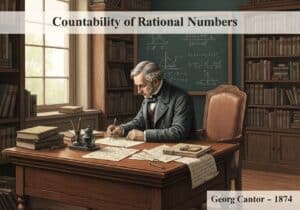
Un número real es racional si y solo si su representación decimal es periódica. Esto significa que la secuencia de dígitos eventualmente repite una secuencia finita de dígitos indefinidamente. Esta parte repetida se llama período. Por ejemplo, [latex]1/3 = 0.333…[/latex] (el período es ‘3’) y [latex]3/7 = 0.428571428571…[/latex] (el período es ‘428571’). Los decimales finitos son un caso especial donde el período es ‘0’.
The connection between rational numbers and periodic decimal expansions is a fundamental result in number theory. Any rational number [latex]p/q[/latex] can be converted to a decimal by performing long division of [latex]p[/latex] by [latex]q[/latex]. Since there are only [latex]q[/latex] possible remainders (0 to [latex]q-1[/latex]), the sequence of remainders must eventually repeat. Once a remainder repeats, the sequence of digits in the quotient also repeats, creating a periodic expansion.
Por el contrario, cualquier decimal periódico puede convertirse en una fracción. Para un decimal finito, la conversión es sencilla (por ejemplo, [latex]0.75 = 75/100 = 3/4[/latex]). Para un decimal periódico, se utiliza manipulación algebraica. Por ejemplo, sea [latex]x = 0.333…[/latex]. Entonces [latex]10x = 3.333…[/latex]. Restando la primera ecuación de la segunda se obtiene [latex]9x = 3[/latex], por lo que [latex]x = 3/9 = 1/3[/latex]. Un método similar funciona para cualquier decimal periódico.
This property provides a clear distinction between rational and irrational numbers. Irrational numbers, like [latex]\pi[/latex] or [latex]\sqrt{2}[/latex], have decimal expansions that are non-terminating and non-repeating. The length of the repetend (period) of a rational number [latex]p/q[/latex] (in lowest terms) is related to the prime factors of the denominator [latex]q[/latex]. Specifically, the length of the period is the order of 10 modulo [latex]q'[/latex], where [latex]q'[/latex] is the part of [latex]q[/latex] that is coprime to 10.
UNESCO Nomenclature: 1101
Álgebra, teoría de números y teoría de grupos.
Precursores
- invention of the decimal system
- development of long division algorithm
- introduction of decimal fractions by Simon Stevin
- study of modular arithmetic
Aplicaciones
- algorithms for converting fractions to decimals in calculators and computers
- detection of rational numbers in numerical analysis
- cryptography based on properties of periodic sequences
- computer science for understanding floating-point representation limitations
Ideas para posibles innovaciones
Debido al bloqueo del tráfico generado por bots, que actualmente supera los 40.000 al día, este contenido está reservado para los miembros de la comunidad.
> Iniciar sesión < o > Registrarse < (100% gratis) para acceder a esto, al igual que a todo el demás contenido y herramientas restringidos.
Related to: decimal expansion, periodic decimal, repeating decimal, rational number, fraction, long division, number theory, repetend, terminating decimal, irrational number.