Product Design, Manufacturing & Innovation Resources
» 탑다운 나노소재 합성

탑다운 나노소재 합성

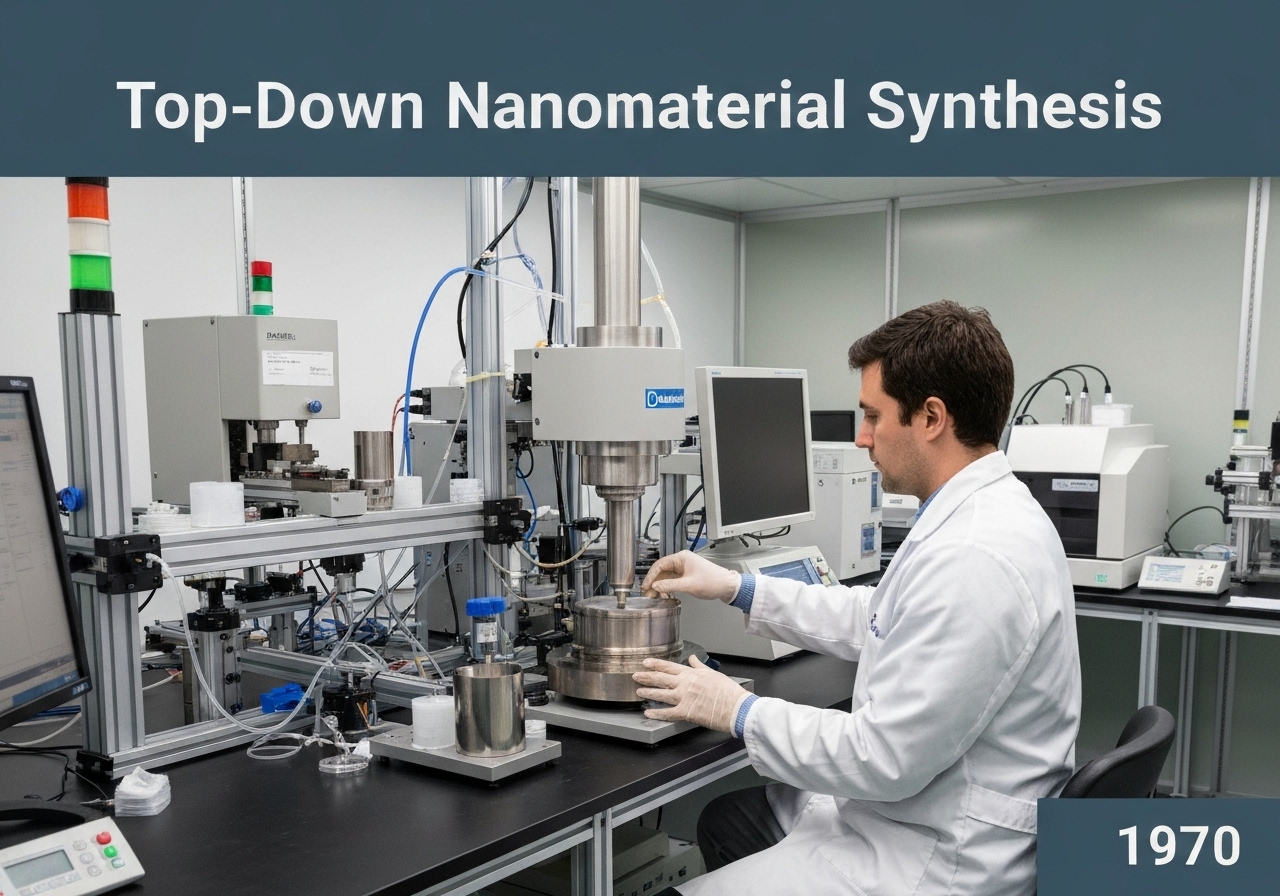
1970
클린룸에서 볼밀을 조작하여 상향식 나노물질 합성을 진행하는 연구원.

(설명을 위한 생성된 이미지입니다)

탑다운 합성법은 더 큰 벌크 재료에서 시작하여 이를 나노 크기로 분해하거나 패턴화하여 나노 재료를 만드는 방법입니다. 주요 기술로는 볼 밀링과 같은 기계적 방법과 포토리소그래피, 전자빔 리소그래피, 나노임프린트 리소그래피와 같은 리소그래피 방법이 있습니다. 이러한 방법들은 구조화된 표면이나 집적 회로를 만드는 데 자주 사용되지만, 표면 결함이 발생할 수 있다는 단점이 있습니다.

Top-down approaches are conceptually straightforward: they are an extension of traditional microfabrication techniques to smaller dimensions. The most prominent example is lithography, the cornerstone of the semiconductor industry. In photolithography, a light-sensitive polymer (photoresist) is coated onto a substrate. A mask is used to selectively expose the resist to UV light, causing a chemical change that allows for the selective removal of either the exposed or unexposed regions. The underlying material can then be etched or deposited upon, transferring the pattern from the mask to the substrate. To achieve nanoscale features, shorter wavelength light sources (e.g., extreme ultraviolet, EUV) or alternative patterning sources like electron beams (e-beam lithography) are used. E-beam lithography offers very high resolution but is a slow, serial process, making it unsuitable for mass production but excellent for prototyping and mask making.

Another major class of top-down methods is mechanical attrition. High-energy ball milling, for instance, places a bulk material in a container with hard grinding media (balls). The container is rotated at high speed, causing the balls to collide with and fracture the material, progressively reducing its particle size down to the nanometer scale. This method is simple and scalable for producing large quantities of nanopowders but offers poor control over particle shape and size distribution, and can introduce impurities from the milling media.

탑다운 방식, 특히 리소그래피의 주요 장점은 집적 회로에 필수적인 넓은 영역에 걸쳐 정밀하게 정렬된 복잡한 구조를 만들 수 있다는 점입니다. 그러나 에칭 또는 밀링 공정 중에 결정학적 손상 및 표면 결함이 발생할 수 있다는 점이 중요한 단점이며, 이는 재료의 특성에 부정적인 영향을 미칠 수 있습니다.

UNESCO Nomenclature: 2211
고체물리학

유형

화학 공정

분열

점진적

용법

널리 사용됨

전구체

  • 인쇄기의 발명과 초기 석판 인쇄
  • 사진술의 발전과 감광성 화학물질의 개발
  • the invention of the transistor and the subsequent drive for miniaturization in electronics
  • 에칭 공정을 위한 진공 기술 및 플라즈마 물리학의 발전

응용 프로그램

  • 컴퓨터 마이크로프로세서 및 메모리 칩 제조
  • fabrication of microelectromechanical systems (mems)
  • 생의학 응용을 위한 패턴 표면 제작
  • 세라믹 및 복합재료용 나노분말 생산
  • 나노임프린트 리소그래피용 금형 제작

특허:

NA

잠재적 혁신 아이디어

현재 하루 4만 건이 넘는 봇 트래픽을 차단하기 위해 이 콘텐츠는 커뮤니티 회원만 이용할 수 있습니다.
> 로그인 < 또는 >등록 < 이 콘텐츠를 비롯한 모든 제한된 콘텐츠와 도구는 (100% 무료로) 이용할 수 있습니다.

관련 용어: 탑다운 합성, 리소그래피, 포토리소그래피, 전자빔 리소그래피, 볼 밀링, 미세 가공, 반도체, 에칭, 나노패터닝, MEMS.

역사적 맥락

탑다운 나노소재 합성

1962
1963
1965
1970
1970
1974-11-15
1980
1962
1963
1964
1968
1970
1970
1975
1980

(날짜를 알 수 없거나 관련이 없는 경우, 예를 들어 "유체역학"의 경우, 주목할 만한 등장 시기를 대략적으로 추정하여 제공합니다.)

관련 발명, 혁신 및 기술 원칙

고화질 이미지 및 다운로드는 등록된 회원에게만 100% 무료로 제공됩니다.

> 로그인 <