Product Design, Manufacturing & Innovation Resources
» Small Satellite Constellations

Small Satellite Constellations

2010
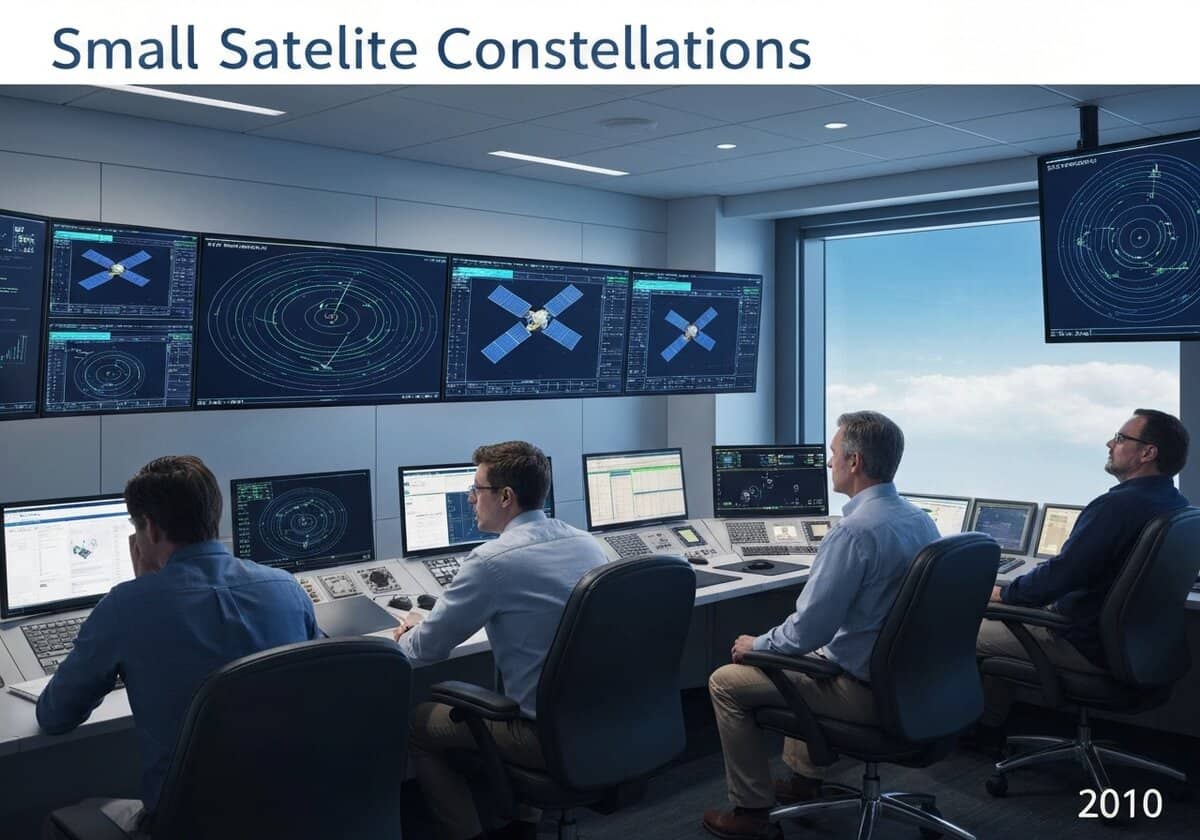
항공우주 엔지니어들이 소형 위성군 운영을 모니터링하는 관제실.

(설명을 위한 생성된 이미지입니다)

A group of numerous small satellites orbiting in a coordinated formation to achieve a common objective that a single, larger satellite cannot. These constellations provide global or near-global coverage with high revisit rates. Key applications include global broadband internet (Starlink), daily Earth observation (Planet Labs), and maritime/aviation tracking (Spire Global), enabled by the low cost of individual satellites.


The concept of a satellite constellation is not new; the GPS system is a prime example. However, the ‘NewSpace’ revolution has been defined by mega-constellations composed of hundreds or thousands of small satellites in Low Earth Orbit (LEO). This architecture is fundamentally different from traditional geostationary (GEO) satellites. While a single GEO satellite can cover a large region, LEO satellites have a much smaller field of view and move rapidly across the sky. Therefore, a large number must be used in concert to provide continuous coverage.

This approach offers several advantages. The low altitude reduces signal latency, which is critical for applications like broadband internet. The high number of satellites provides high temporal resolution, or ‘revisit rate’, allowing for near-constant monitoring of the Earth’s surface. Furthermore, the system is resilient; the failure of a single satellite has minimal impact on the overall service. The primary challenge is deployment and maintenance. Launching thousands of satellites is a massive logistical and financial undertaking. On-orbit management requires sophisticated automation for station-keeping, collision avoidance, and de-orbiting at the end of life to mitigate the growing problem of space debris. For communications constellations, inter-satellite links (often using lasers) are necessary to route data around the globe without relying on ground stations.

UNESCO Nomenclature: 3302
항공우주공학

유형

시스템 아키텍처

분열

실질적인

용법

널리 사용됨

전구체

  • 1990년대의 이리듐 위성군 개념
  • 초창기 매우 성공적인 군사 위성 시스템으로서의 글로벌 위치 확인 시스템(GPS)
  • 우주선에 적용되는 대량 생산 기술의 발전
  • development of low-cost small satellite buses like the CubeSat
  • 차량 공유 모델을 통한 저렴한 출발 옵션 이용 가능

응용 프로그램

  • global satellite internet services (e.g., starlink, oneweb)
  • 지구 전체를 고해상도로 매일 촬영한 이미지 (예: 플래닛 랩스의 비둘기자리)
  • 실시간 선박 및 항공기 추적 (예: 스파이어 글로벌의 레무르 위성)
  • internet of things (iot) connectivity (e.g., swarm technologies)
  • 기상 예측을 위한 전파 차폐 현상 (예: 지구광학)

특허:

NA

잠재적 혁신 아이디어

현재 하루 4만 건이 넘는 봇 트래픽을 차단하기 위해 이 콘텐츠는 커뮤니티 회원만 이용할 수 있습니다.
> 로그인 < 또는 >등록 < 이 콘텐츠를 비롯한 모든 제한된 콘텐츠와 도구는 (100% 무료로) 이용할 수 있습니다.

관련 용어: 위성군, 저궤도 위성, 메가 위성군, 스타링크, 원웹, 플래닛 랩스, 지구 관측, 전 세계 서비스 범위, 우주 쓰레기, 위성 간 연결.

역사적 맥락

Small Satellite Constellations

2000
2000
2003
2010
2013-09-24
2000
2000
2002
2010
2013

(날짜를 알 수 없거나 관련이 없는 경우, 예를 들어 "유체역학"의 경우, 주목할 만한 등장 시기를 대략적으로 추정하여 제공합니다.)

관련 발명, 혁신 및 기술 원칙

고화질 이미지 및 다운로드는 등록된 회원에게만 100% 무료로 제공됩니다.

> 로그인 <