프라운호퍼 선은 태양의 광학 스펙트럼에서 나타나는 어두운 흡수선 집합입니다. 이 선들은 태양 내부의 뜨거운 빛이 특정 파장에서 방출되어 광구에 있는 차가운 원자와 이온에 흡수될 때 발생합니다. 각 선은 특정 원소의 특정 전자 전이에 해당하며, 이를 통해 지구에서 태양의 화학적 조성을 파악할 수 있습니다.

(설명을 위한 생성된 이미지입니다)
프라운호퍼 선은 태양의 광학 스펙트럼에서 나타나는 어두운 흡수선 집합입니다. 이 선들은 태양 내부의 뜨거운 빛이 특정 파장에서 방출되어 광구에 있는 차가운 원자와 이온에 흡수될 때 발생합니다. 각 선은 특정 원소의 특정 전자 전이에 해당하며, 이를 통해 지구에서 태양의 화학적 조성을 파악할 수 있습니다.
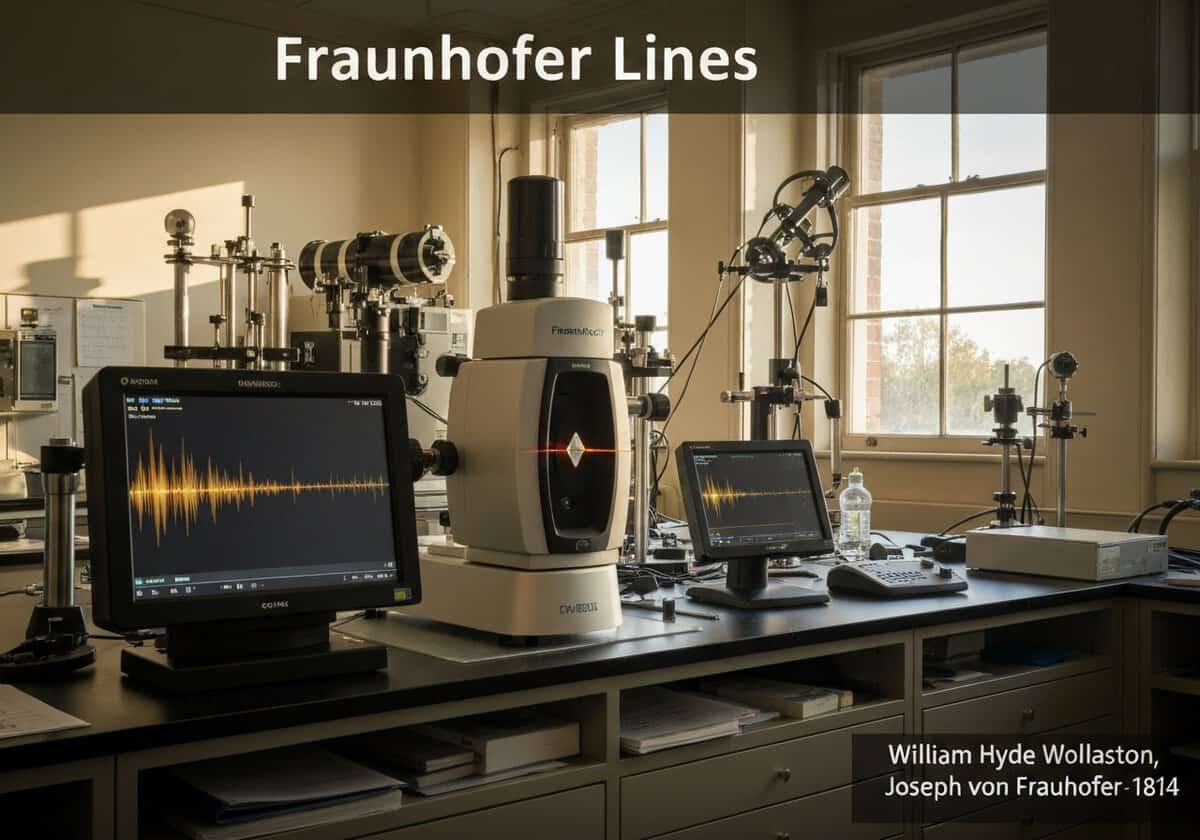
In 1802, William Hyde Wollaston first noted the existence of dark lines in the solar spectrum. However, it was Joseph von Fraunhofer who, in 1814, independently rediscovered and systematically studied these lines using a high-quality prism and telescope, mapping over 570 of them. He labeled the most prominent lines with letters from A to K, a notation still used today. The profound significance of these lines was not understood until 1859, when Gustav Kirchhoff and Robert Bunsen established that the pattern of lines was unique to each chemical element. They realized that the dark lines in the solar spectrum matched the bright emission lines of known elements when heated. This led to the groundbreaking conclusion that the Fraunhofer lines are absorption spectra. Light from the Sun’s continuous spectrum, produced by its hot, dense core (photosphere), passes through the cooler, less dense outer layers (chromosphere). Atoms in the chromosphere absorb photons at the precise frequencies corresponding to their allowed electronic transitions, re-emitting them in random directions. This process effectively removes those specific frequencies from the light reaching Earth, creating the dark lines. This discovery transformed astronomy from a science of position and motion to one of astrophysics, enabling the study of the physical nature and chemical makeup of distant stars.
현재 하루 4만 건이 넘는 봇 트래픽을 차단하기 위해 이 콘텐츠는 커뮤니티 회원만 이용할 수 있습니다.
> 로그인 < 또는 >등록 < 이 콘텐츠를 비롯한 모든 제한된 콘텐츠와 도구는 (100% 무료로) 이용할 수 있습니다.
프라운호퍼 라인
(날짜를 알 수 없거나 관련이 없는 경우, 예를 들어 "유체역학"의 경우, 주목할 만한 등장 시기를 대략적으로 추정하여 제공합니다.)

고화질 이미지 및 다운로드는 등록된 회원에게만 100% 무료로 제공됩니다.
> 로그인 <