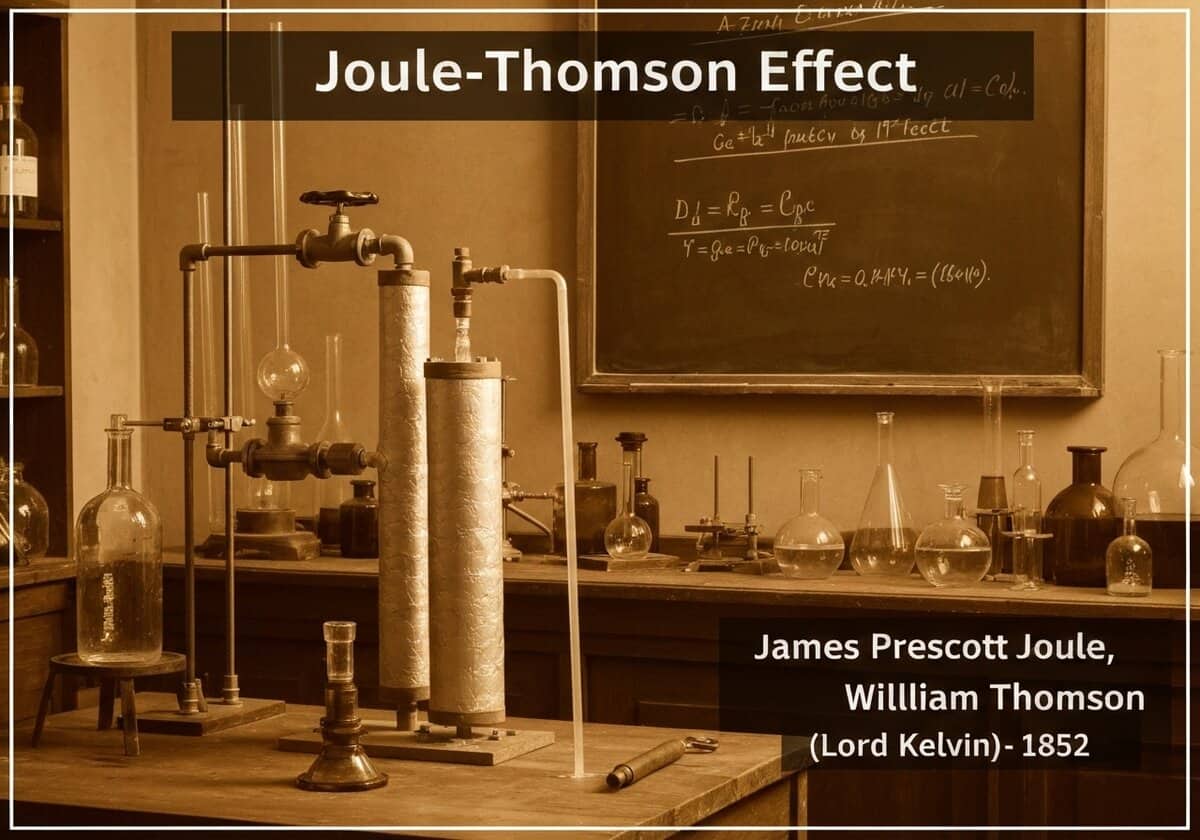
줄-톰슨 효과(또는 줄-켈빈 효과)는 단열된 상태(등엔탈피 과정)에서 기체가 밸브나 다공성 마개를 통해 강제로 통과될 때 발생하는 온도 변화를 설명합니다. 주어진 온도에서 압력기체는 역전 온도를 가지고 있습니다. 이 온도 이하에서 팽창시키면 냉각되고, 이 온도 이상에서 팽창시키면 가열됩니다. 이러한 냉각 효과는 현대 냉동 및 액화 기술의 핵심 원리입니다.


(설명을 위한 생성된 이미지입니다)
줄-톰슨 효과(또는 줄-켈빈 효과)는 단열된 상태(등엔탈피 과정)에서 기체가 밸브나 다공성 마개를 통해 강제로 통과될 때 발생하는 온도 변화를 설명합니다. 주어진 온도에서 압력기체는 역전 온도를 가지고 있습니다. 이 온도 이하에서 팽창시키면 냉각되고, 이 온도 이상에서 팽창시키면 가열됩니다. 이러한 냉각 효과는 현대 냉동 및 액화 기술의 핵심 원리입니다.
The effect arises from the work done against intermolecular forces (van der Waals forces) as the gas expands. For an ideal gas, where intermolecular forces are negligible, the Joule-Thomson coefficient [latex]\mu_{JT} = (\frac{\partial T}{\partial P})_H[/latex] is zero, meaning no temperature change occurs. However, for real gases, these forces are significant. When a gas expands, the average distance between molecules increases. If attractive forces dominate (as they do at lower temperatures), the molecules must do work to overcome these forces, converting internal kinetic energy into potential energy, which results in a temperature decrease. Conversely, at high temperatures, repulsive forces can dominate, and expansion can lead to an increase in temperature. The temperature at which the effect switches from cooling to heating is the inversion temperature. This discovery was crucial for liquefying ‘permanent’ gases like oxygen and nitrogen, which have very low inversion temperatures, requiring pre-cooling before throttling could be effective.
현재 하루 4만 건이 넘는 봇 트래픽을 차단하기 위해 이 콘텐츠는 커뮤니티 회원만 이용할 수 있습니다.
> 로그인 < 또는 >등록 < 이 콘텐츠를 비롯한 모든 제한된 콘텐츠와 도구는 (100% 무료로) 이용할 수 있습니다.
줄-톰슨 효과
(날짜를 알 수 없거나 관련이 없는 경우, 예를 들어 "유체역학"의 경우, 주목할 만한 등장 시기를 대략적으로 추정하여 제공합니다.)

고화질 이미지 및 다운로드는 등록된 회원에게만 100% 무료로 제공됩니다.
> 로그인 <